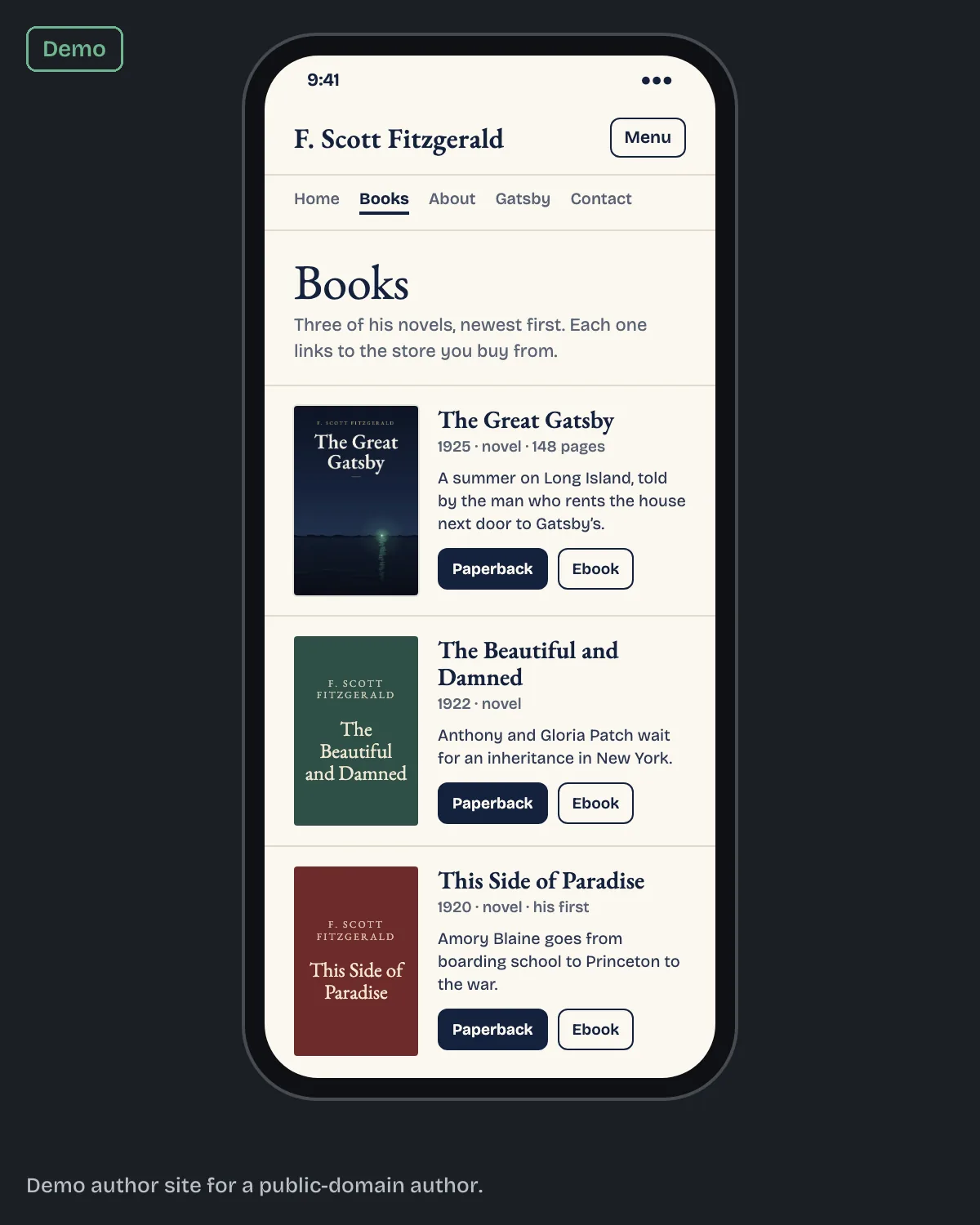
Short answer. You need three author website pages, or sections: your books with buy links, a short bio and photo, and a contact or mailing list form. All three fit on one scrolling page. Add books and featured book pages once you have a series, a list or ads. Skip the blog, shop and press kit until readers ask.
Key points
- Three things every author site needs: books, bio, a way to reach you.
- All three fit on one scrolling page, which is what our one-page author website is.
- A featured book page earns its place when you send ads or a launch to one title.
- A blog, a shop and a press page cost time to keep up. Add them when there is demand.
- Check every page on a phone first. That is where buttons get buried.
What pages does an author website need first?
An author website needs your books, who you are, and a way for readers to reach you. Nothing else is required to do the job. A reader who lands on your site wants the next book and the buy button, then maybe a line about you. If the site gives them those three, it works.
Those three can be three sections of one page. The book section shows covers with buy links. The bio is short, with a photo. The form at the bottom collects emails or messages.
When does each one need its own page?
When one section gets too long to scroll past. With one to three books, a single page holds everything. Once you have a series, a list of eight covers pushes the bio and the form far down, and readers on a phone stop before they reach them.
That is the point where the five-page layout helps: home, books, about, a featured book and contact. Each page does one job. Our post on what an author website costs shows what each size includes at $449 and $849.
What goes on a featured book page?
One title, with room to sell it. A longer description than the home page can hold, review lines you have permission to use, and buy links for every store you sell in.
This page matters most when you point traffic at one book. An ad, a launch email or a podcast mention should land on the book, not on a home page where the reader has to hunt for it.
Which author website pages can you skip?
Skip a blog, a shop, a press kit and an events page until you have a reason for each. Every page you add is a page you have to keep current, and an empty events page or a blog last updated two years ago tells a reader the site is abandoned. Start with the three that sell.
A shop that takes payments is the biggest job of the four. Buy links that go to Amazon and other stores do the same work without tax, shipping or card fees on your side.
What did we learn about pages from building our own site?
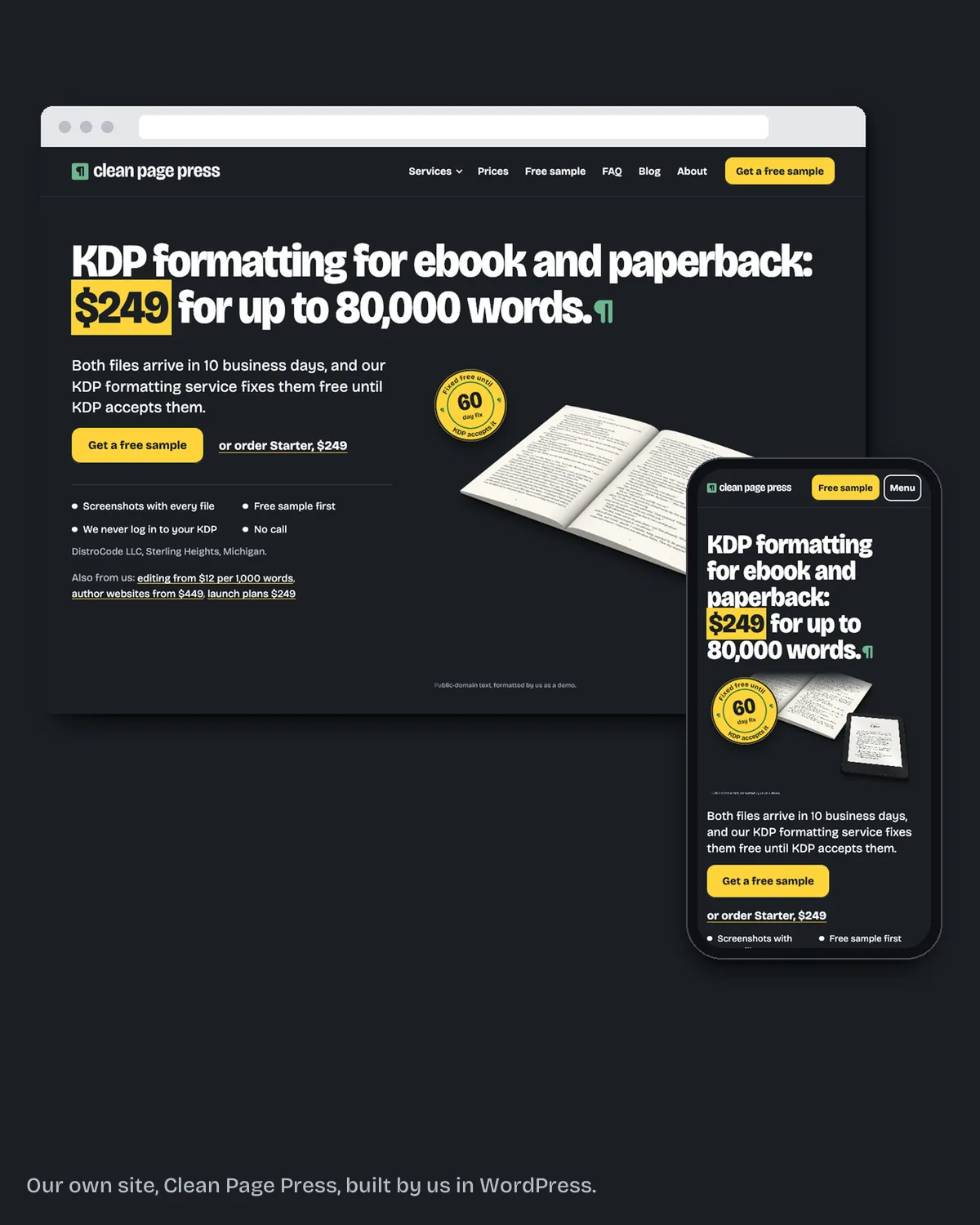
That the order of a page matters more than the number of pages. When we measured the first build of our own site, cleanpagepress.com, on a 390 px phone screen before it went live on 12 October 2026, 10 of its 11 pages showed no button in the first screen. The first button sat between 927 and 2,601 px down.
Every page looked fine on a desktop. So we moved the buttons up, and now every author site we build is checked at phone width before the author sees it.
The fix we do for this: we plan the pages with you, build them in WordPress in your own account, and check each one on a phone. Tell us about your books and we reply with a page plan and the price.
Do you need an About page if you have a bio on Amazon?
Yes, but it can be short. Your Amazon Author Page follows Amazon's layout, and Amazon's help lists no way to add a mailing list form to it. Your own About section can link to your list and your other books in one place. Our post on author website vs Amazon Author Central compares the two side by side.
How do you decide between one page and five?
Count your books and ask where your traffic comes from. One to three books and no ads: one page. A series, a mailing list you are growing, or ads to one title: five pages. Our post on choosing a one-page author website or five pages walks through the call with examples.
If you want to see how bestselling authors arrange the same pages, our author website examples post looks at ten live sites by genre.
What else do authors ask about author website pages?
Your books with buy links, a short bio with a photo, and a contact or mailing list form.
No. Add one only if you will post on a schedule.
Not at first. Buy links to stores do the job without payments, tax or shipping on your side.
Home, books, about, one featured book and contact.
Yes. The site is WordPress in your account, so pages can be added at any time.
What should you do next?
Open your site, or the draft of it, on your phone. Count how far you scroll before the first buy link. If it is more than one screen, move the books up before you add a single new page. If you would rather we build it, start on our author website page.