Short answer. Copyediting vs proofreading: the copyedit does more. A proofread catches spelling, punctuation and typos for $16 per 1,000 words. A copyedit fixes grammar, consistency and clarity, and ours includes the proofread, for $24 per 1,000 words. On a 70,000-word book that is $1,120 against $1,680.
Key points
- Proofread: spelling, punctuation, typos. $16 per 1,000 words, 5 business days per 50,000 words.
- Copyedit: grammar, consistency, clarity, plus the proofread. $24 per 1,000 words, 10 business days per 50,000 words.
- The extra $8 per 1,000 words buys the decisions: which spelling, which rule, applied every time.
- Never buy both from us. The copyedit already includes the proofread.
- A book nobody has edited usually needs the copyedit.
Copyediting vs proofreading: what is the difference?
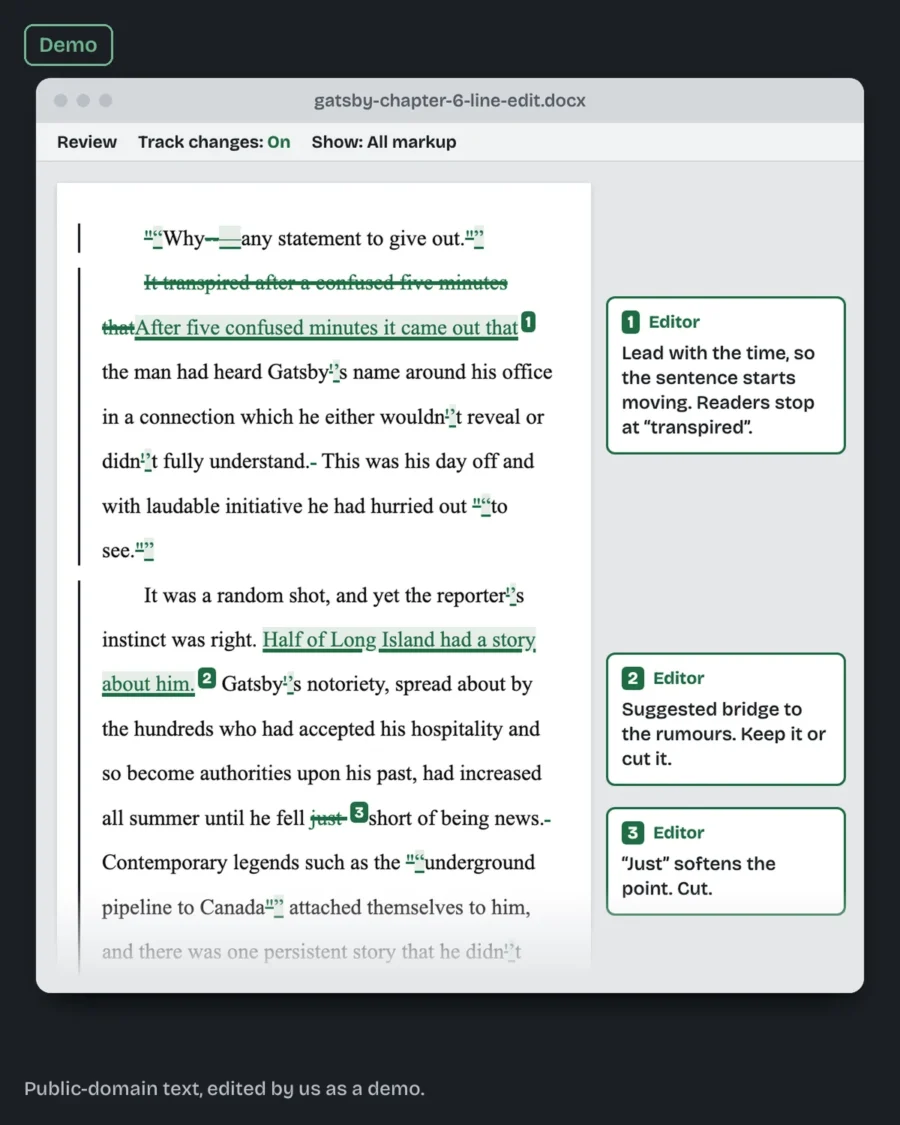
A proofread checks that the text is correct as written: a misspelled word, a missing period, a doubled "the". A copyedit asks whether the text is consistent and clear: the same spelling every time, grammar that holds, a sentence a reader will not have to read twice. The copyedit makes decisions. The proofread catches slips.
Both sit at the bottom of the editing ladder. Neither one touches structure or rewrites for style. For those, see our post on developmental, line and copy editing. In traditional publishing a proofreader reads the typeset pages; for a self-published book we proofread the manuscript before formatting, so the pages are set once.
What does each one cost?
A proofread costs $16 per 1,000 words and a copyedit costs $24 per 1,000 words, both on our book editing page. The gap is $8 per 1,000 words, or $560 on a 70,000-word novel. The copyedit also takes twice as long: 10 business days per 50,000 words against 5.
| Word count | Proofread | Copyedit (includes proofread) |
|---|---|---|
| 50,000 | $800 | $1,200 |
| 70,000 | $1,120 | $1,680 |
| 80,000 | $1,280 | $1,920 |
| 100,000 | $1,600 | $2,400 |
For outside prices, Reedsy's editing cost guide, read on 13 October 2026, lists proofreading at $0.014 to $0.021 a word and copy editing at $0.020 to $0.032. Our $0.016 and $0.024 sit inside both ranges. Our post on what proofreading costs per word goes further into per-word and per-page quotes.
What does a proofread catch that a copyedit doesn't?
Nothing. Our copyedit includes the proofread, so everything a proofread catches, a copyedit catches too. The difference runs the other way. A proofread will not decide between two spellings you used, rework a sentence whose grammar fails, or flag a fact that changes between chapters.
That is why ordering both from us would be paying twice for the same final pass.
Where does the line fall on a real page?
We tested it on 13 October 2026 with our sample chapter, the opening of Pride and Prejudice, 849 words. It is the file behind our formatting samples, and we set it up the way many manuscripts arrive: typed in Word, double spaced, with the spellings and dashes of the 1813 text left in.
A proofread of that chapter flags two spots where a dash was typed as two hyphens: "go--or" and "girls--though". It flags "develope", which is the 1813 spelling and a typo in a book written today. Those are slips with one right answer.
A copyedit asks more. "Neighbourhood" appears 3 times and "humour" twice, in British spelling. "Some one", "new comers" and "over scrupulous" are open where US style closes them. Should the book follow British or US spelling? A copyeditor picks one and applies it everywhere. A proofreader leaves it, because none of it is a typo.
The fix we do for this: if your book has never been edited, a copyedit at $24 per 1,000 words gets the decisions and the proofread in one pass. Tell us your word count and we reply with the price and the dates.
Which one does your manuscript need?
Buy the proofread if someone has already edited the book and you need the final check. Buy the copyedit if nobody has, or if you know you change your mind about spellings and capitals as you write. If your notes from readers are about how the sentences read, neither is the right edit: that is a line edit.
A quick test: search your manuscript for one word you know you spell two ways, like "OK" and "okay". If both turn up, you need a copyedit.
Do you need either one before formatting?
Edit before formatting, whichever you pick. Every change after the pages are set can push text onto the next page, and then the page breaks shift. When you order editing and formatting together from us, the formatting days start when you approve the edited file. If you are pricing the whole book, our post on what book formatting costs covers the formatting side.
Our post on whether you need a proofreader before KDP covers what KDP checks for you and what it does not.
What else do authors ask about copyediting and proofreading?
Yes. $24 per 1,000 words against $16 here, and the copyedit includes the proofread.
Yes. A proofread on its own is $16 per 1,000 words.
A proofread takes 5 business days per 50,000 words. A copyedit takes 10 business days per 50,000 words.
No. It fixes grammar, consistency and clarity. Style work is a line edit.
No. A spellchecker passes a real word in the wrong place, like "their" for "there".
What should you do next?
Search your manuscript for two words you might spell two ways. If you find a pair, buy the copyedit. If the book has been edited and you find none, the proofread is enough. Either way, the prices are on our book editing page.