Short answer. Developmental editing vs line editing vs copy editing comes down to depth. A developmental edit fixes the book's structure. A line edit fixes how each sentence reads. A copyedit fixes grammar and consistency. Pick the deepest problem you still have. Most books need one of the three, not all three. If you need more than one, go in that order.
Key points
- Developmental edit: structure, plot or argument, pacing and character. $35 per 1,000 words, $299 minimum.
- Line edit: rhythm, clarity and word choice, sentence by sentence. $30 per 1,000 words, $149 minimum.
- Copyedit: grammar, consistency and clarity, with a proofread included. $24 per 1,000 words.
- Work from the deepest problem down. Sentence work on a chapter you later cut is paid for twice.
- Not sure? A manuscript assessment, $12 per 1,000 words, tells you which one.
Developmental editing vs line editing vs copy editing: what is the difference?
The three edits look at your book from different heights. A developmental edit looks at the whole book: does the structure hold, does the pacing work. A line edit looks at each sentence: does it read well. A copyedit looks at the rules: grammar, consistency, clarity. Each one assumes the level above it is already sound.
Here is how they compare on our book editing page:
| Edit | What it fixes | What you get back | Price per 1,000 words | Business days |
|---|---|---|---|---|
| Developmental | Structure, plot or argument, pacing, character | A written report plus notes in your manuscript's margins | $35, $299 minimum | 15 up to 80,000 words |
| Line | Rhythm, clarity, word choice | Tracked changes in your Word file | $30, $149 minimum | 10 up to 80,000 words |
| Copyedit | Grammar, consistency, clarity; includes proofread | Edited manuscript | $24 | 10 per 50,000 words |
When do you need a developmental edit?
You need a developmental edit when the problem is the shape of the book, not its sentences. Beta readers stall at the same point. A subplot never pays off. You keep moving chapters and nothing settles. No amount of sentence polish fixes those, because the problem sits above the sentences.
You get a written report on structure and pacing, plus notes in the margins next to the scenes they are about. You make the changes yourself. Our post on what a developmental edit costs works through the price for 8,000 to 90,000 words.
When do you need a line edit?
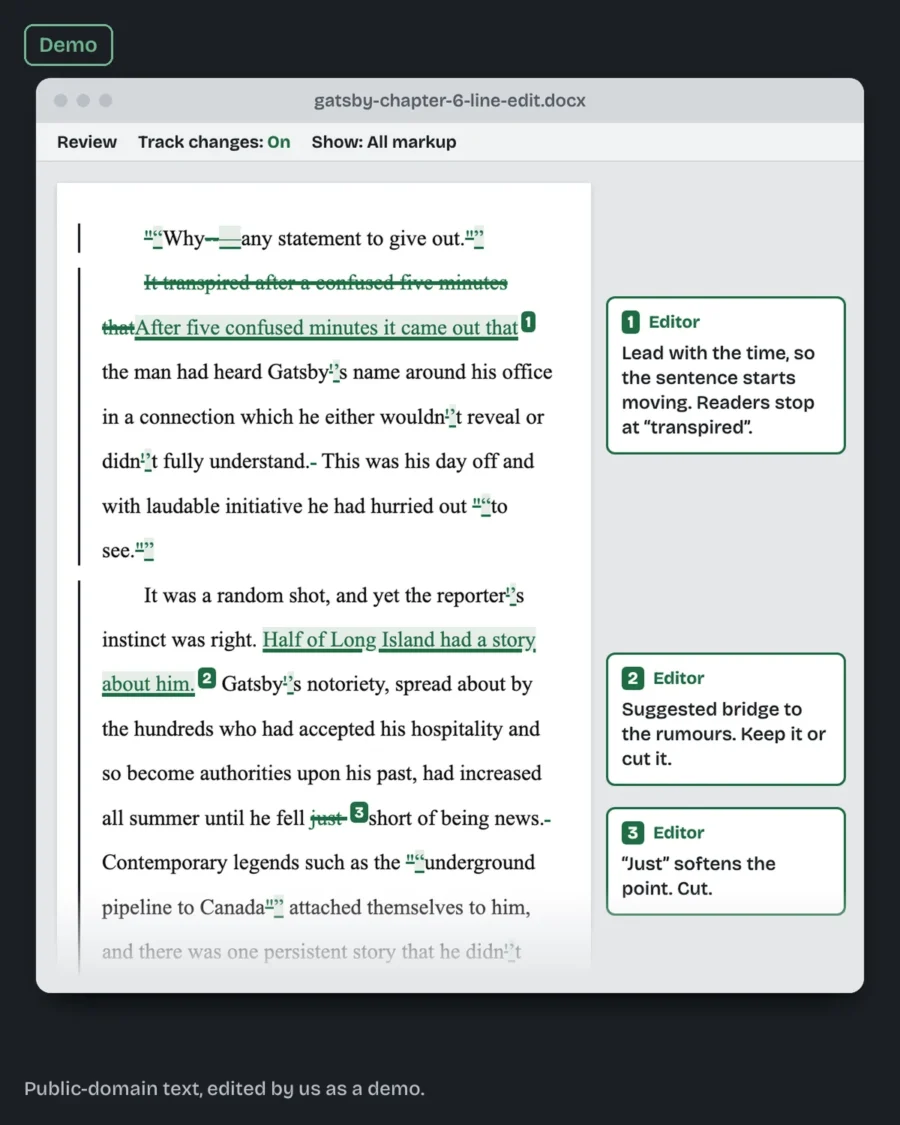
You need a line edit when the story works but the writing drags. Readers finish the book, and their notes are about clunky sentences, repeated words or paragraphs they had to read twice. A line editor rewrites at the sentence level, as tracked changes you accept or reject one by one.
For a 70,000-word novel, a line edit is $2,100 in 10 business days. Our post on line editing cost has the table for other lengths.
When is a copyedit enough?
A copyedit is enough when your sentences already read the way you want, and what is left is correctness. Grammar slips, a character's eye color that changes between chapters, a word spelled two ways. Our copyedit includes the proofread, so it is the last edit before formatting.
We tested where the line falls on our own sample chapter, the opening of Pride and Prejudice (849 words), on 13 October 2026. A copyeditor's questions there are about consistency, not style. "Neighbourhood" appears 3 times and "humour" twice, all in British spelling. "Some one", "new comers" and "over scrupulous" are written as two words where a modern US style closes them up.
A copyeditor would not rewrite Austen's sentences. The job is to pick one rule for each of those and apply it every time. That is a copyedit, and for a 70,000-word book it is $1,680 here.
The fix we do for this: if you cannot tell which of the three your book needs, tell us your word count and the problem you keep hitting. We reply with the edit we would pick, the price and the dates.
Do you need all three edits?
Most self-published books do not need all three. If structure is the problem, start with the developmental edit, revise, then decide whether the sentences need a line edit. If structure is fine, start with the line edit or the copyedit. Running all three on a 70,000-word book here would cost $6,230.
The order matters more than the count. A developmental edit almost always leads to new and cut scenes. Line editing or copyediting before that means paying for sentences that will not survive.
What if you cannot tell which problem you have?
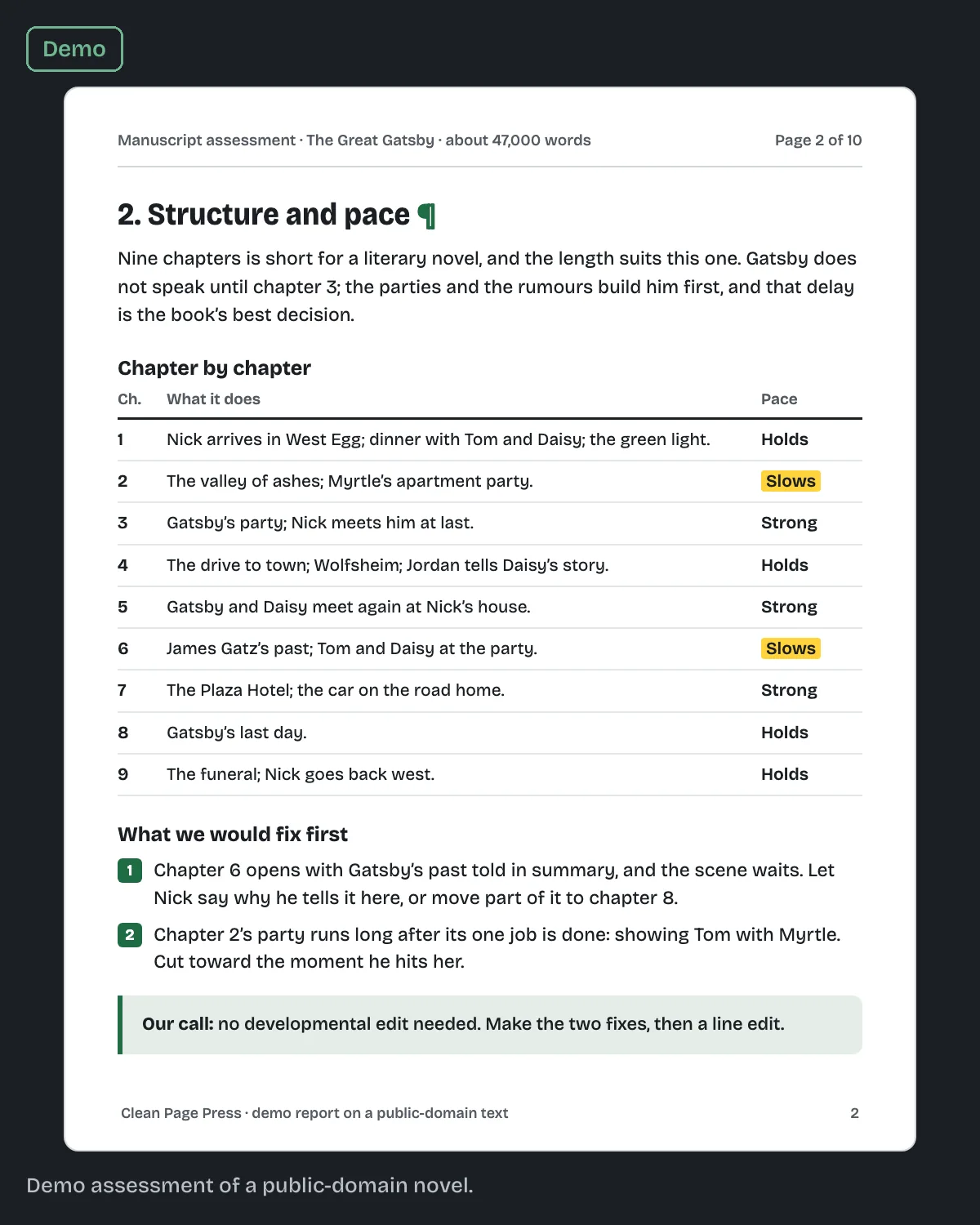
Buy the assessment first. A manuscript assessment is a report of 8 to 12 pages on what works and what does not, with no edits in the text. It costs $12 per 1,000 words, with a $199 minimum, and takes 7 business days up to 80,000 words. For a 70,000-word book that is $840.
That report tells you whether the structure needs work before you spend $2,450 on a developmental edit, or whether the book is ready for a line edit or a copyedit.
Where does a proofread fit?
A proofread comes last and catches spelling, punctuation and typos. On its own it costs $16 per 1,000 words. Our copyedit already includes one, so you do not need to buy both. A proofread alone fits a book that has been edited and only needs the final check.
Our post on copyediting vs proofreading covers what each catches and where the line between them falls.
What else do authors ask about the three kinds of edit?
The developmental edit, at $35 per 1,000 words with a $299 minimum.
Yes, if readers finish the book and their notes are about sentences, not story.
No. A line edit is about how sentences read; a copyedit is about grammar and consistency.
Developmental first, then line, then copyedit, then format. Each step changes the text the next one works on.
Yes. Every change after the pages are set can move a page end, so we set the pages once, after the last edit.
What should you do next?
Write down the last three notes a reader gave you. If they are about the story, look at a developmental edit. If they are about sentences, a line edit. If they are about mistakes, a copyedit. If you still cannot tell, send them to us from the book editing page and we will say which edit we would pick.